
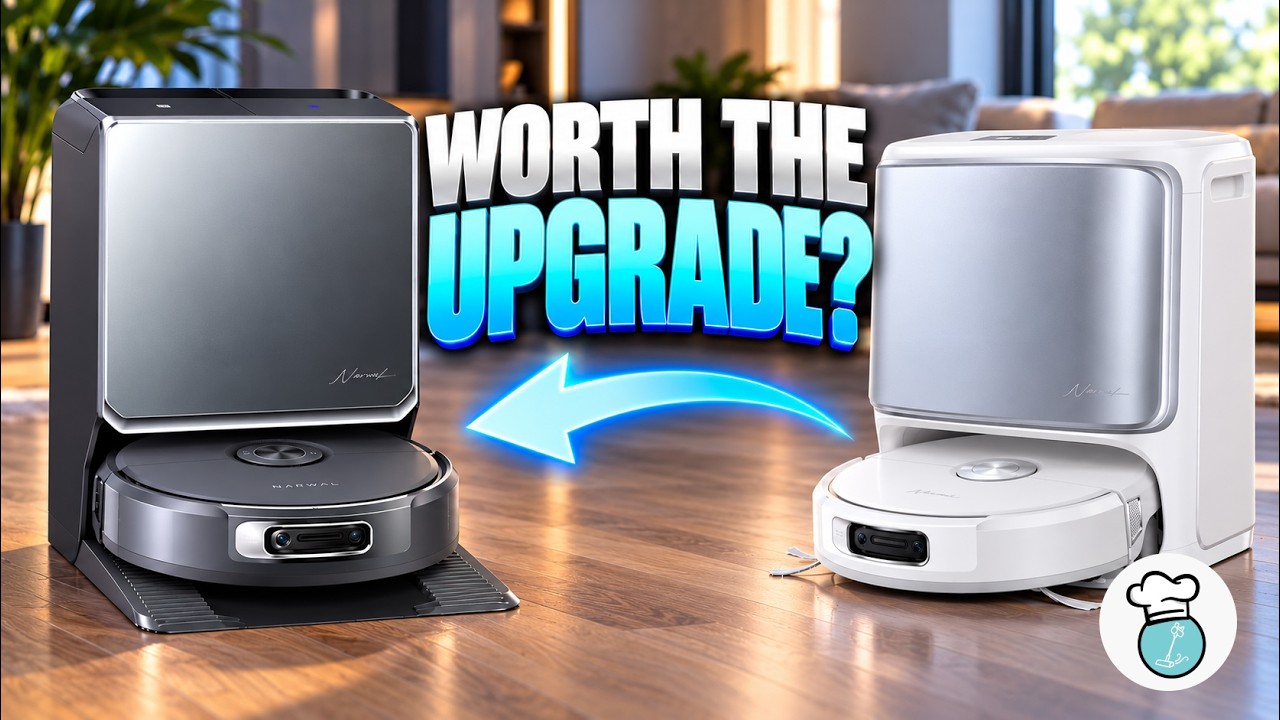
Choosing between the Narwal Flow 2 and the original Narwal Flow can be challenging, especially since both models offer advanced vacuuming, roller-style mopping, AI-powered obstacle avoidance, and impressive pet-hair management. While the newer Flow 2 introduces several upgrades, does it actually deliver better cleaning performance than its predecessor?
In this comparison, we’ll take a closer look at both models, examining their design, vacuuming performance, mopping capabilities, navigation, smart features, app functionality, and customer feedback. We’ll also highlight where each robot performs best to help you decide which one offers the better overall experience.
NARWAL Flow 2 Robot Vacuum and Mop Combo, 31,000Pa Suction, FlowWash Self-Cleaning Mop, AI Object Recognition, Self-Emptying & Refilling, 212℉ Hot Water Mop Washing & Drying, Tangle-Free Design

NARWAL Flow Robot Vacuum and Mop Combo, FlowWash Real-Time Self-Cleaning Track Mop, 22,000 Pa Suction, Dual-Camera AI Obstacle Avoidance, Carpet & Edge Cleaning, Self-Emptying Robot Vacuum (Renewed)

Note: Narwal previously provided these products as samples for testing. However, this comparison is not sponsored, and we conducted it independently.
1. Design and Build Quality
At first glance, the Narwal Flow 2 and original Narwal Flow share a very similar design. Both robots stand just 3.7 inches tall, making them suitable for cleaning underneath many beds, sofas, and other low-clearance furniture. Neither model features a retractable LiDAR tower, allowing them to maintain a relatively low profile.
One of their standout design features is the FlowWash roller mop system. Unlike traditional robot mops that rely on dual spinning mop pads, both Narwal models use a roller-style mop that continuously cleans itself with fresh water while mopping. This helps maintain a cleaner roller throughout the cleaning process.
Their brush systems are another major similarity. Both robots feature tangle-resistant designs that we consider among the best we’ve seen for managing pet hair. However, there are some differences in how their brushes are configured. The Flow 2 uses dual short rollers alongside an upgraded long-bristle side brush, while the original Flow features a single-side-roller design with an asymmetrical side brush intended to reach farther into corners.
Neither model has an extending side brush, but both feature extending mops to improve edge cleaning. While this helps them reach closer to walls and furniture edges, neither robot achieves perfect corner coverage.
2. Vacuuming Performance: Does Higher Suction Mean Better Cleaning?
Vacuuming performance is where the comparison becomes particularly interesting. On paper, the Narwal Flow 2 appears to have a significant advantage, with advertised suction power of 31,000 Pa compared with 22,000 Pa for the original Narwal Flow.
However, our carpet measurements tell a different story. Despite having lower advertised suction power, the original Flow delivered better results across the carpet measurements available to us.
In our testing, the original Flow recorded 411 feet per minute of carpet airflow and 0.52 kPa of carpet pressure. The Flow 2, meanwhile, measured 394 feet per minute and 0.38 kPa, respectively. The difference was also reflected in our carpet coffee test, where the original Flow scored 95 compared with 80 for the Flow 2.
| Performance Metric | Narwal Flow | Narwal Flow 2 |
|---|---|---|
| Advertised suction power | 22,000 Pa | 31,000 Pa |
| Carpet airflow | 411 ft/min | 394 ft/min |
| Carpet pressure | 0.52 kPa | 0.38 kPa |
| Carpet coffee test | 95 | 80 |
| Maximum listed noise | 72.8 dB | 79.6 dB |
Noise levels also favor the original model. Its listed maximum noise level is 72.8 dB, compared with 79.6 dB for the Flow 2. This could be worth considering if you prefer running your robot vacuum while working, relaxing, or spending time at home.
Both models feature a 300 ml onboard dustbin and automatic dust emptying. However, they differ in their dust bag designs. The original Flow uses a 2.5-liter disposable dust bag advertised to last up to four months, while the Flow 2 features a reusable dust bag. This is a welcome advantage for anyone who would rather avoid regularly purchasing replacement bags.
Both robots also include CarpetFocus technology, which lowers the brush cover to concentrate airflow when cleaning carpets while lifting the mop to help prevent carpets from getting wet.
Overall, although the Flow 2 has higher advertised suction power, the original Flow performed better in our available carpet tests and was also quieter based on its listed maximum noise level.
3. Mopping Performance: A Strong Point for Both Models
Mopping is one of the biggest strengths of both Narwal robots. Their FlowWash systems continuously clean the roller mop using fresh water, scrape away accumulated dirt and residue, and collect dirty water separately. This helps keep the mop cleaner throughout the cleaning process rather than simply spreading dirt around the floor.
Both models also feature automatic mop washing and drying, along with self-cleaning functions for their base stations. These features help reduce the amount of manual maintenance required, making them convenient options for everyday floor cleaning.
Another useful feature is their extending mop design, which allows both robots to clean closer to walls and along edges. While this improves overall coverage, some corners may still be missed.
The biggest difference between the two models comes down to their mop-washing systems. The Flow 2 supports hot-water mop washing at temperatures of up to 212°F, while the original Flow is listed at up to 167°F. The newer model also supports automatic cleaning-solution dispensing, a feature that the original Flow does not offer.
These upgrades give the Flow 2 an advantage in terms of mop maintenance and convenience. However, both models offer impressive roller-style mopping systems that remain among their most appealing features.
4. Navigation and Smart Features
Both the Narwal Flow and Flow 2 use dual cameras and AI-powered obstacle avoidance to identify and navigate around everyday household objects. They also support video monitoring, allowing users to check in on their homes remotely.
The original Flow is advertised to recognize more than 200 types of objects, while the Flow 2 introduces an upgraded vision-language AI system designed to identify common household items such as shoes, cables, and pet bowls. These systems are intended to help the robots avoid obstacles rather than simply bumping into them and changing direction.
However, neither model is completely free from navigation issues. Customer feedback for both robots mentions occasional mapping problems, missed cleaning areas, and instances of the robots getting stuck underneath furniture. While these reports don’t necessarily reflect everyone’s experience, they’re worth keeping in mind when considering either model.
Both robots advertise up to 190 minutes of battery life, although actual runtime will depend on cleaning settings, floor conditions, and the size of the home.
The Flow 2 also introduces several additional smart features. These include interactive pet-related functions, a smart light bar for status updates, and more customizable cleaning behavior around sensitive areas. For example, users can adjust the robot to operate more quietly when cleaning near a baby’s crib.
The original Flow, meanwhile, supports voice control through Amazon Alexa, Google Assistant, Siri, and Narwal’s built-in voice assistant.
While both models offer advanced navigation and obstacle avoidance, the Flow 2 has the advantage when it comes to additional smart features and customization.
5. App and Software Experience
Both robots use the NARWAL app, which is available on iOS and Android devices. At the time of this comparison, the app has a rating of 3.4 out of 5 stars.
Despite its mixed rating, the app offers a good range of controls for managing everyday cleaning routines. Users can select individual rooms, create schedules, manage maps, establish no-go zones, and customize cleaning preferences according to their needs.
The Flow 2 offers some additional customization options, including the ability to adjust room settings for more intensive cleaning or quieter operation. It also supports external wall adjustments, which can help users customize how the robot approaches room boundaries.
The original Flow has a reported software quirk where the app defaults to avoiding carpets. This may require users to manually change the settings to achieve their preferred cleaning behavior.
Overall, both models provide plenty of app-based control, although mapping consistency and ease of use remain areas where customer experiences vary. The Flow 2 offers more flexibility in certain areas, but the overall experience still depends on how reliably the software performs in your home.
6. Customer Reviews: What Are Owners Saying?
Beyond our own testing, customer feedback provides another perspective on how these robots perform in everyday homes.
Owners of the Narwal Flow 2 frequently praise its cleaning performance, particularly its ability to pick up pet hair while minimizing tangles. These are important strengths for households with pets, where hair buildup can often be a challenge for robot vacuums.
However, feedback is more mixed when it comes to mapping, customization, reliability, and overall value for money. Some customers have also reported more serious functionality issues, suggesting that the experience may not be consistent for every owner.
The original Narwal Flow also receives positive comments for its ability to pick up cat hair, operate relatively quietly, and map rooms quickly. On the downside, some owners report missed floor sections, difficulties navigating underneath beds, and occasional reliability problems.
It’s important to remember that these are individual customer experiences rather than controlled test results. Nevertheless, they highlight some potential issues worth considering before purchasing either model.
7. Narwal Flow 2 vs. Narwal Flow: Which One Should You Buy?
After comparing their design, vacuuming performance, mopping capabilities, navigation, smart features, and customer feedback, it’s clear that both models have their own advantages.
The original Narwal Flow is particularly appealing if carpet cleaning performance and lower noise levels are your priorities. Despite its lower advertised suction power, it delivered better results in our available carpet tests, including higher airflow, greater carpet pressure, and a better coffee test score. Its lower listed maximum noise level is another advantage worth considering.
The Narwal Flow 2, on the other hand, offers a more advanced feature set. Its higher advertised suction power, reusable dust bag, hotter mop washing, automatic cleaning-solution dispensing, and additional smart features make it an appealing alternative for anyone who values convenience and newer technology.
Final Verdict
So, which robot vacuum and mop should you choose?
If you prioritize measured carpet performance and quieter operation, the original Narwal Flow may be the better option based on our available test results. Despite being the older model, it managed to outperform the Flow 2 in several important carpet measurements.
However, if you prefer more advanced features, higher advertised suction power, a reusable dust bag, and improved mop maintenance, the Narwal Flow 2 offers several worthwhile upgrades.
Ultimately, both robots deliver strong mopping capabilities and impressive pet-hair management. However, neither is perfect when it comes to corner cleaning and navigation reliability.
Your final decision will depend on which features matter most to you and how much you’re willing to spend.
NARWAL Flow 2 Robot Vacuum and Mop Combo, 31,000Pa Suction, FlowWash Self-Cleaning Mop, AI Object Recognition, Self-Emptying & Refilling, 212℉ Hot Water Mop Washing & Drying, Tangle-Free Design
NARWAL Flow Robot Vacuum and Mop Combo, FlowWash Real-Time Self-Cleaning Track Mop, 22,000 Pa Suction, Dual-Camera AI Obstacle Avoidance, Carpet & Edge Cleaning, Self-Emptying Robot Vacuum (Renewed)
Leave feedback about this