
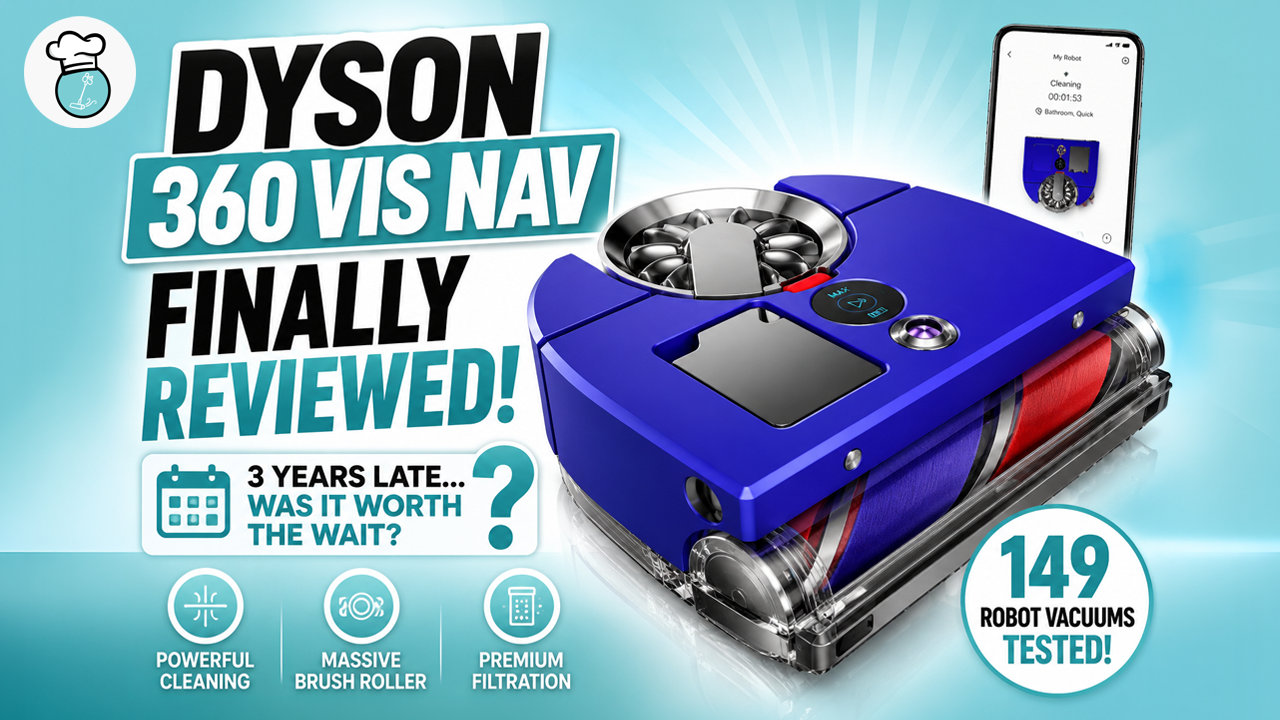
The Dyson 360 Vis Nav is one of the most interesting robot vacuums we’ve had the opportunity to test, even if we arrived at the party a little late. Although it first launched in 2023, we finally got our hands on one three years later to see whether Dyson’s ambitious approach to robot vacuum design still holds up against today’s competition.
- Powerful suction
- Industry-leading carpet agitation for deep dirt removal
- Excellent fine dust removal
- Oversized full-width brush roller improves pickup
- Squared-front design reaches corners better
- Washable, high-quality filter
- Poor obstacle avoidance
- Short battery life
- No mopping feature
- Brush roller tangles long hair easily
- Lacks modern flagship features

This is our first Dyson robot vacuum review, but it’s the 149th robot vacuum we’ve tested overall, giving us a solid benchmark for comparison. I originally wanted to buy the Vis Nav when it launched, but I couldn’t justify paying flagship pricing for a robot that, even at the time, lacked many of the smart features offered by competing models. Still, I’ve always wondered whether its carpet cleaning performance truly lived up to the hype.
As a longtime fan of the iRobot Roomba S9+, I’ve always viewed the Dyson 360 Vis Nav as Dyson’s answer to that legendary carpet-cleaning robot—perhaps even its spiritual successor. While that comparison may be a bit of a stretch, it’s hard not to see the similarities in design philosophy.
For transparency, this review is not sponsored. We purchased this unit ourselves, so everything here is based entirely on our own testing and experience.
Unboxing & Setup
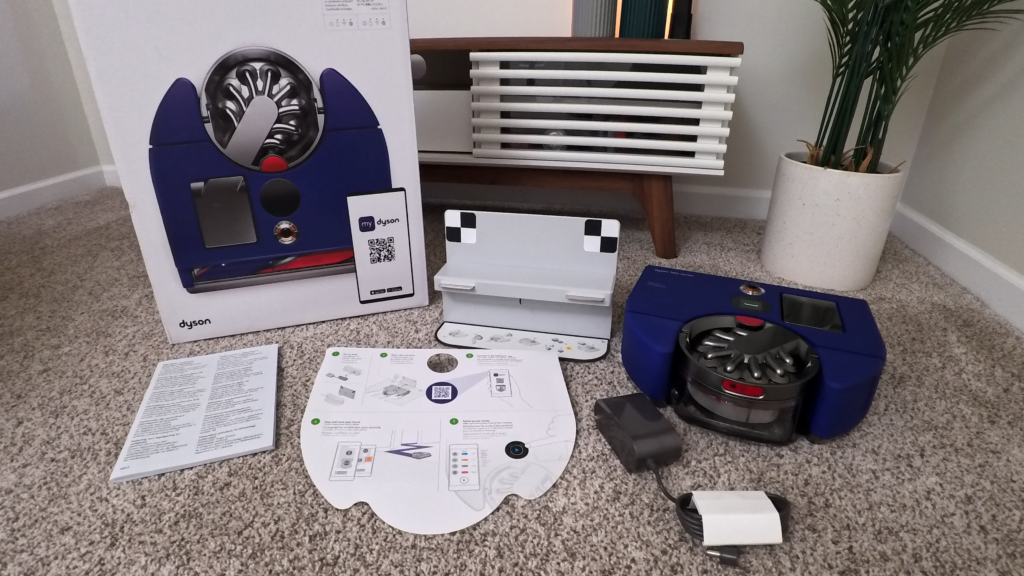
Dyson keeps the unboxing experience refreshingly simple. Inside the box you’ll find the robot vacuum, charging dock, power supply, and the usual documentation. There’s nothing extravagant here, but everything you need to get started is included.
Setup is quick and straightforward. After connecting the power supply to the dock and charging the robot, you’ll simply pair it with the My Dyson app on either iOS or Android. Within a few minutes, the robot is ready to map your home and begin cleaning.
Design & Build Quality
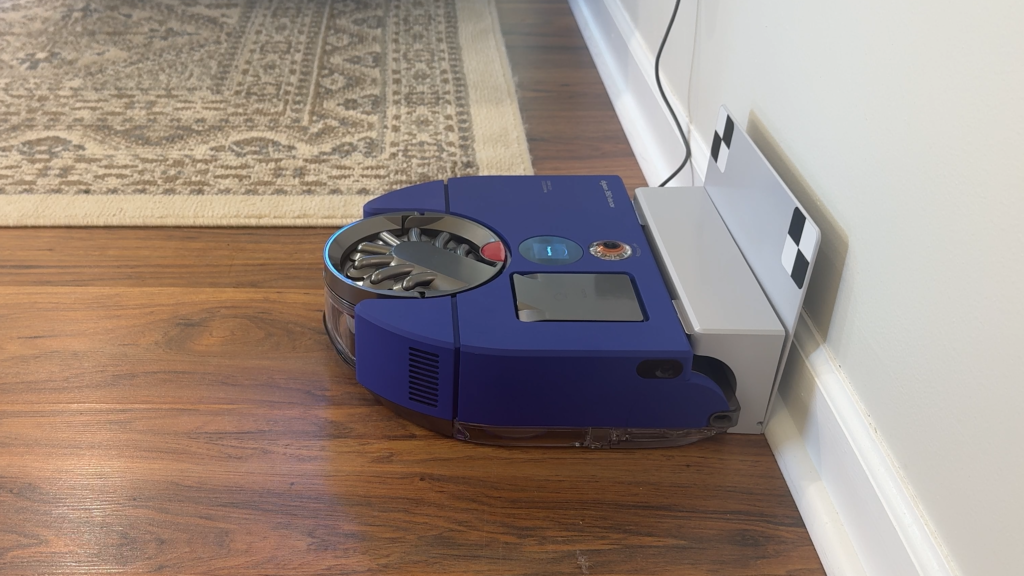
The Dyson 360 Vis Nav immediately stands out from nearly every other robot vacuum on the market. Rather than following the familiar round design used by most manufacturers, Dyson opted for a distinctive squared-off front that gives the robot a unique appearance while also helping it reach deeper into corners. It certainly won’t appeal to everyone, but it’s refreshing to see a company willing to try something different instead of producing another generic-looking robot.
Dyson’s signature blue and silver color scheme also helps the Vis Nav stand apart. In a market dominated by black and white plastic discs, the premium finish gives the robot a personality that’s unmistakably Dyson.
The real engineering highlight, however, is the oversized main brush roller. Instead of using a conventional robot vacuum brush, Dyson essentially adapted the cleaning hardware from one of its cordless stick vacuums and built the robot around it. That decision ends up paying significant dividends in real-world cleaning performance.
The premium construction continues throughout the robot. The filter assembly feels exceptionally robust, the dustbin is well engineered, and even small details—like the molded water faucet icon on the washable filter—show the level of attention Dyson put into the design.
Unfortunately, the charging dock doesn’t receive the same level of attention. It’s little more than a charging station with no self-emptying capability or maintenance features. Even when the Vis Nav launched, this felt like a missed opportunity. By today’s standards, where self-emptying docks have become commonplace, the omission is even harder to overlook.
Features
While the Dyson 360 Vis Nav excels in build quality and cleaning hardware, its feature set feels surprisingly conservative.
Unlike today’s flagship robot vacuums, there’s no front-facing camera for obstacle avoidance, no extending side brush for improved edge cleaning, no mopping system, and no self-emptying dock. Buyers looking for those features will need to consider Dyson’s newer offerings, although early reviews of the company’s Spot Plus Scrub model have been mixed.
Interestingly, that newer model also marks a shift in Dyson’s robot vacuum strategy, with reports suggesting portions of the development were outsourced rather than engineered entirely in-house. Whether that proves beneficial remains to be seen, but it certainly makes the original 360 Vis Nav feel like the final chapter of Dyson’s original robot vacuum vision.
Cleaning Performance
If there’s one area where the Dyson 360 Vis Nav continues to impress, it’s cleaning performance.
On paper, its advertised suction of 8,100 Pa doesn’t seem particularly remarkable anymore. In fact, it’s well below the average suction figures advertised by many modern flagship robots. However, our testing once again demonstrated that suction specifications alone tell very little about real-world cleaning ability.
Using our standardized airflow testing, the Dyson achieved an impressive 600 feet per minute (FPM) of airflow on carpet, making it the third-highest result we’ve ever recorded and well above our current average of 428 FPM.
Even more impressive was its carpet pressure. At 1.02 kPa, the Vis Nav produced the highest carpet pressure we’ve ever measured from a robot vacuum—nearly three times the average. That’s approaching the performance of some cordless stick vacuums and comes surprisingly close to the Levoit LVAC 200.
Much of this success comes down to Dyson’s oversized brush roller and how effectively it seals against carpet fibers. The result is outstanding debris extraction and exceptional fine dust pickup.
Throughout testing, the robot consistently filled its dustbin with noticeably more ultra-fine dust than we typically see from robot vacuums. While many robots leave carpets looking clean, the Dyson often revealed just how much embedded dust remained beneath the surface.
Deep Cleaning Tests
Our standardized carpet tests produced equally impressive results. The Dyson removed 95% of coffee grounds, 65% of sand, and 93% of cat litter from carpet, all comfortably above average.
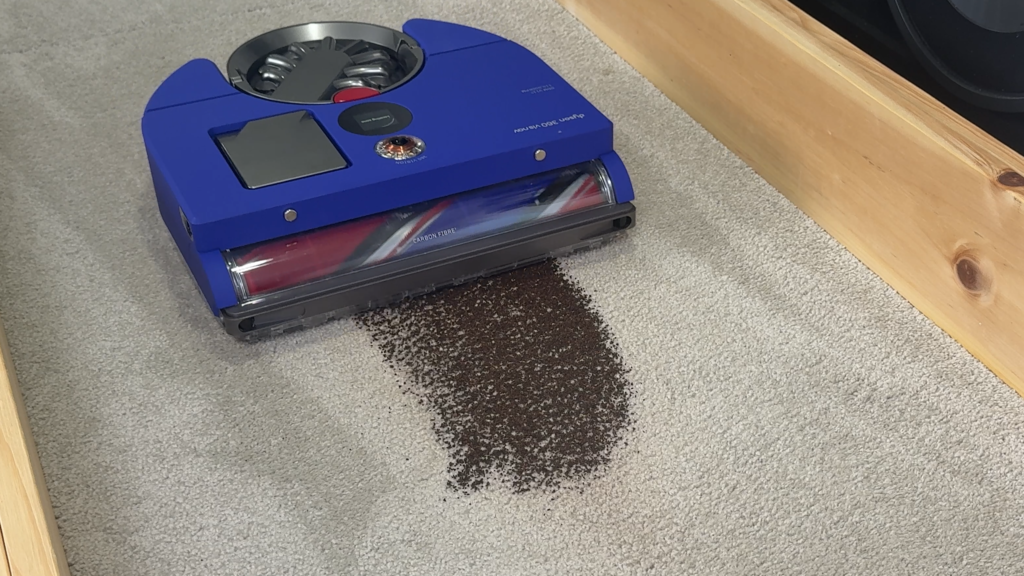
I’ll admit my expectations may have been a little unrealistic. Given Dyson’s reputation and the performance we observed during everyday cleaning, I half expected perfect scores on coffee grounds and cat litter, along with a new record for sand pickup.
While it didn’t quite reach those lofty expectations, the results remain excellent—especially for a robot vacuum that launched several years ago.
More importantly, standardized testing only tells part of the story. During daily use around my own home, the Dyson consistently pulled remarkable amounts of fine dust from carpets. In fact, it’s made me question whether our testing methodology should eventually include a dedicated ultra-fine dust test to better capture performance differences like these.
Navigation & Obstacle Avoidance
Cleaning performance may be exceptional, but navigation is where the Dyson begins to show its age.
Even though the robot lacks a dedicated front-facing obstacle avoidance camera, we subjected it to the same standardized obstacle course used for every robot vacuum we review.
Unfortunately, the results were disappointing.
The Dyson earned an overall obstacle avoidance score of just 21%, the lowest score we’ve recorded to date. It struggled with nearly every obstacle we placed in its path, particularly charging cables and simulated pet waste. Larger objects were easier for it to recognize, but even then, collisions were common enough that we’d hesitate to let it clean unsupervised in cluttered areas.
The robot also tended to leave a noticeable gap around walls, corners, and baseboards. Ironically, its squared-off front appears specifically designed to improve corner cleaning, yet conservative navigation often prevents it from getting close enough to fully capitalize on that design advantage.
The My Dyson App
The My Dyson app is clean, responsive, and easy to navigate, although it’s fairly light on advanced features. Users can create multiple maps, establish no-go zones, clean individual rooms (or “zones,” as Dyson calls them), and adjust suction settings without much difficulty.
One notable omission is true tap-to-clean spot cleaning, which has become a standard feature among many competing apps.
One feature we genuinely appreciated, however, is Dyson’s post-clean dust heat map. After each cleaning session, the app visually highlights where the robot detected the highest concentrations of dirt throughout the home. It’s an informative visualization that provides useful insight into your cleaning habits, and we’d love to see more manufacturers adopt a similar approach.
What Owners Are Saying
Customer feedback largely mirrors our own experience. Owners consistently praise the Dyson’s exceptional carpet cleaning performance, premium build quality, and ability to remove fine dust that many competing robots leave behind.
Most criticisms focus on its limited battery life, inconsistent navigation, lack of obstacle avoidance, and the absence of premium features such as self-emptying and mopping. The general consensus is that the Dyson 360 Vis Nav is an outstanding vacuum but a less capable robot.
Where Dyson Could Improve
The most obvious upgrade would be a larger battery. Extending runtime would make the Vis Nav’s impressive cleaning performance much more practical for larger homes and reduce the frequency of recharge-and-resume cycles.
Improving navigation would also make a significant difference. Whether through a front-facing camera, LiDAR enhancements, or another dedicated obstacle avoidance system, smarter navigation would help the robot better utilize its excellent cleaning hardware.
The oversized brush roller is another double-edged sword. While it’s one of the primary reasons for the robot’s excellent carpet performance, it also collects long hair more readily than many competing designs, meaning regular brush maintenance will be necessary for homes with pets or long-haired family members.
Finally, considering its premium launch price, the absence of a self-emptying dock remains difficult to justify.
Final Verdict
After spending considerable time testing the Dyson 360 Vis Nav, one conclusion stands above everything else: this is a vacuum first and a robot second.
Dyson absolutely succeeded in building one of the strongest carpet-cleaning robot vacuums we’ve ever tested. Its oversized brush roller, exceptional carpet pressure, outstanding airflow, and remarkable ability to extract fine dust allow it to compete with some of the very best cleaning performers available today.
Unfortunately, the overall ownership experience feels rooted in an earlier generation of robot vacuums. Limited battery life, dated navigation, poor obstacle avoidance, and the absence of modern conveniences like self-emptying and mopping make it difficult to recommend over many of today’s flagship competitors.
Even so, the Dyson 360 Vis Nav deserves recognition for proving that thoughtful engineering still matters. While much of the industry has focused on adding features, Dyson prioritized cleaning performance above everything else—and the results speak for themselves.
Ultimately, the Dyson 360 Vis Nav remains one of the most fascinating robot vacuums we’ve tested. It’s a product filled with genuinely brilliant engineering, but also one that leaves you wondering just how exceptional it could have been had Dyson paired its class-leading cleaning hardware with the smart features that define today’s best robot vacuums.
- Powerful suction
- Industry-leading carpet agitation for deep dirt removal
- Excellent fine dust removal
- Oversized full-width brush roller improves pickup
- Squared-front design reaches corners better
- Washable, high-quality filter
- Poor obstacle avoidance
- Short battery life
- No mopping feature
- Brush roller tangles long hair easily
- Lacks modern flagship features